Showing posts with label science sunday. Show all posts

Sunday, 29 July 2012

Science Sunday: ZomBees

Have you ever wondered what an insect version of a Night of the Living Dead-Alien-crossover might be like? No, me neither. But lets imagine for a minute that we did. The infected might just end up something like zombie bees - or ZomBees.

Photo by John Hafernik (SFSU Department of Biology)
Once infected, the usually diurnal bees - much like horror movie zombies - leave their hives during the night, form groups and are attracted to light sources. However, unlike fictional zombies, the bees will eventually die from their condition. 


Photo by John Hafernik (SFSU Department of Biology)
Unlike insects afflicted by the fungi genus cordyceps, this strange phenomena is caused by the phorid fly species Apocephalus borealis. This parasitic fly was previously thought only to target bumble bees and paper wasps, but has adapted to using the already declining honey bees as its host in recent years as well. A female fly seeks out the target insect and, after locating a weak point on the bee's abdomen, inserts her eggs inside using a syringe-like ovipositor on her rear. The fly larvae then begin to consume the bee from the inside out and also seem to affect their victim's brain, causing the aforementioned unusual behavior. Following this, the larvae eat their way out of their now-dead host and prepare for adulthood.


There is currently no cure for the problem at the moment, but setting up a light source near honey bee hives and checking for bees that gather under it or exhibit other symptoms, and then isolating those bees from the rest of the colony seems to help with containment. ZomBee Watch - a joint project funded and run by SFSU's Department of Biology, CCLS, and The Natural History Museum - has been set up to collect data about "zombie bees" and their unwanted "friends" and encourages the public to report the locations in which infected bees have been found.


This post is part of Science Sunday

Sunday, 6 May 2012

May Monster Madness: Monster Voices with Sulfur Hexafluoride

Image Source: Arthur's Monster Clipart

Have you ever wanted to have a mega-deep, booming monster voice to scare your friends with but been disappointed when you found only helium, which makes it super-squeaky instead? Well, stop being disappointed and get yourself some of the chemical compound sulfur hexafluoride instead! 

Helium is much less dense than air and so allows the vocal chords to vibrate at a higher rate, making your voice sound much higher. Sulfur hexafluoride, however, is approximately 5 - 6 times denser than air at room temperature, which forces vocal chords to vibrate more slowly and in turn makes your voice sound much lower. The effects don't last long, unfortunately, but you can sound like an evil monster overlord for a minute or two at least!

Check out the videos below to see the gas in action:


This post is part of the May Monster Madness blog hop & Science Sunday!


Sunday, 9 October 2011

Science Sunday: Spooky Sounds from Saturn


Saturn Aurora — January 28, 2004
Source: Hubblesite.org

Back in 2005, NASA's Cassini spacecraft first recorded some radio waves being emitted from Saturn, known as Saturn Kilometric Radiation (SKR). Even in 2011, it continues to orbit and gather data on Saturn, including SKR, which can be converted into sounds that are audible to the human ear. Although radio waves from planets had been recorded before, Cassini's instruments are of a higher resolution than those of previous crafts, such as NASA's Voyager, which allows it to gather more information and to "convert the radio waves into audio recordings by shifting the frequencies down into the audio frequency range".

The resulting sounds are quite eerie; sounding more like the soundtrack to a creepy sci-fi horror movie than the emissions of a majestically beautiful planet. However, this phenomenon isn't limited to Saturn, and was also first recorded on Earth in 1979. The radio waves coming from both planets produced very similar sounds, and scientists believe that both are related to the Aurora Borealis on Earth and the auroras at Saturn's Northern and Southern poles.

Saturn

It's not just Saturn and Earth either, the noises of space in general are bizarre, like a spooky cosmological opera. Or perhaps I'm just getting carried away now...still, they are hauntingly strange.


To hear space recordings and read more about the Cassini mission, follow the links below:

Sunday, 11 September 2011

Science Sunday: Mind Controlling Cordyceps & Zombie Insects

Imagine you're an ant, going about your day & minding your own business, when all of a sudden you start to feel a little strange. You try to walk down an innocent looking tree, but instead your brain makes you walk up. You don't know what's going on, so you turn to your colony for assistance. They'll know what to do, right? Well it turns out, they do, and quickly drag you as far away from the nest as they can so that you don't infect anyone else. Now you know there's a real problem, which isn't helped when you start to feel a movement inside your tiny exoskeleton. Then, all of a sudden, it all goes black and a weird, alien creature bursts out of your body. R.I.P. Mr. Ant.

Cordyceps infected bee (Photo: Erich G. Vallery, USDA Forest Service)
Whilst that might sound like the plot of a bad B movie, it's actually a (very simplified) version of a real phenomenon. It isn't in fact an alien creature, but a genus of parasitic fungi called cordyceps that attack insects by infecting them with their spores. The spores grow inside the unfortunate bugs until they eventually explode out, causing the death of the effected creature. 


There are literally hundreds of different species of cordyceps, each adapted to prey on individual types of insects. One species, cordyceps unilateralis, implants its spores into unsuspecting insects, infecting their brains and causing them to become living zombies. The cordyceps then forces them to walk as high up into the trees as they can, which goes against their natural behaviour. This ensures that the parasite's spores will spread over the widest area possible when they eventually burst out. Creepy stuff!

Sunday, 14 August 2011

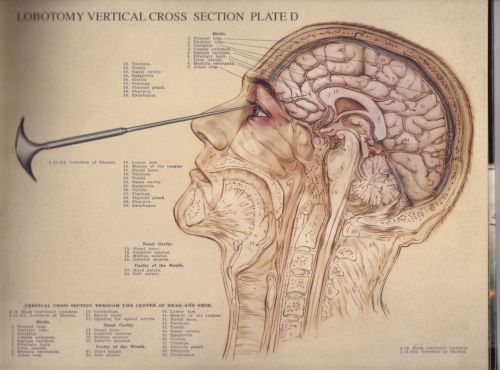
Science Sunday: Lobotomies

Lobotomy was a misguided and now largely obsolete psychiatric treatment, in which the prefrontal cortex of the brain would be intentionally damaged by inserting a long pointed rod, called an orbitoclast, through the eye socket. The orbitoclast was then thrust into the brain with a small hammer, in an attempt to bring about a change in the patient's behaviour. 


The medical technique originally began as a neurological practice in 1935, and lasted well to the 1950's. The practice cost the lives of many patients that went through it, due to severing the connecting tissues in the brain that allegedly cause us to worry, in the hope of curing mental illnesses such as Alzheimer's and schizophrenia.


Rather than being cured, those that survived the quick and allegedly painless operation, often had negative repercussions, such as greatly reduced cognitive functioning or severe pain. There were, however, very occasionally some patients, such as 1940's French Canadian singer Alys Robi, who claimed that the lobotomy she was forced to undergo had actually been beneficial to her.

A still from the lobotomy scene in 'Sucker Punch'
Though highly traumatizing in reality, the procedure has inspired many intriguing cinematic scenes in film and television, such as those featured in Stephen King's 'Kingdom Hospital', William Butler's 'Madhouse', and more recently, Zack Snyder's 'Sucker Punch'.

Science Sunday!

There's been Monster Monday and Fright-day Foods but today, my little horrors, we bring you Science Sunday! Every Sunday we'll be updating about things related to the world of real science-related horrors and oddities, as well as mad scientists, radioactive ghouls and everything else in the science fiction horror genre.
As with Monster Monday and Fright-day Foods, we'd also love to see submissions from everyone else as well, so if you want to take part in Science Sunday, let us know and we'll link to your post or feature your contribution on HSL! Posts can be about any kind of horror-themed science fiction or real science-related horror. All we ask is that submissions are in by the preceding Saturday so that we have time to compile the list. To submit a link or ask a question, please post a comment on this entry, or e-mail us at: 1x15x5@gmail.com

If you want to be kind and link back to Science Sunday, please use the banner below:

Related Posts Plugin for WordPress, Blogger...